Group-wide · Digital Accessibility · Governance
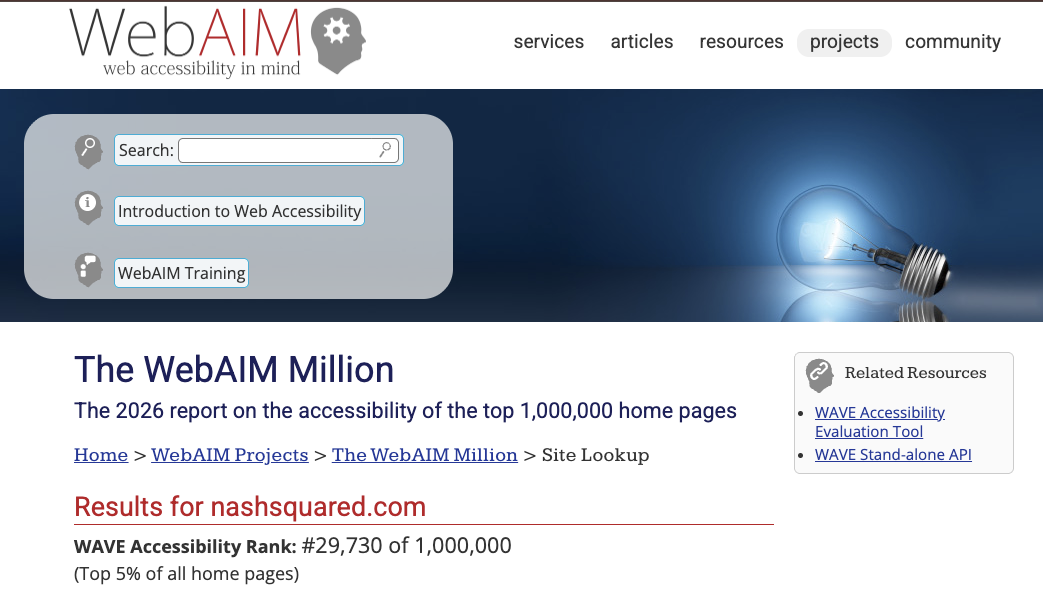
From no oversight to top 4% global accessibility
How I built accessibility into the company DNA and earned a place in the top 4% of the world's 1,000 largest websites.
- Manual Audits
- Automated Scanning
- Show & Tell
- KPI Governance
Section 01 — The Challenge
No oversight. No clarity. Real risk.
Before this work began, the Group had no central view of whether its digital estate met WCAG or the Equality Act. Accessibility lived as scattered effort across teams and suppliers, with no owner, no standards, and no way to prove compliance - putting both users and the brand at risk.
"We didn't know what we didn't know - and that was the biggest risk of all."
— Group digital leadership
Compliance Visibility
1 — None
Scale
1 - No oversight · 5 = Fully governed
for digital accessibility
tied to compliance
for WCAG conformance
Section 02 — Diagnosis
Accessibility was treated as a technical task.
I built an accessibility RAG report and found the following. Audits were non-existant, suppliers worked to different standards, and content authors had no guidance at the point of creation. Without ownership or measurement, fixes never compounded - issues reappeared in the next release, the next document, the next supplier handover.
"You can't remediate your way to compliance. Without ownership and measurement, the same issues come back in the next release."
Section 03 — The Approach
Audit, educate, govern.
I set up a a multi-tier programme that combined rigorous testing with knowledge transfer and leadership accountability - so accessibility moved from a one-off fix into a measurable, owned discipline.
Step 1
Hybrid testing methodology
Run exhaustive manual audits across all Group websites, then validate with automated scanning so findings are accurate, defensible, and prioritised by real user impact.
Section 04 — The Results
From checklist item to competitive advantage.
Accessibility moved from a periodic concern to a continuous, measurable practice - backed by leadership, baked into KPIs, and visible in independent global rankings.
- Global ranking among the 1,000 largest websites (WebAIM)
- Top 4%Global ranking among the 1,000 largest websites (WebAIM)
- Critical transactional journeys regularly verified
- 100%Critical transactional journeys regularly verified
- Accessibility built into targets for every Group site
- KPIsAccessibility built into targets for every Group site
Defined ownership
A designated Lead for Digital Accessibility gave the Group a single point of accountability and a clear escalation path for global standards.
Accessibility in KPIs
Embedding accessibility into performance targets made it a business priority — no longer optional, no longer easy to defer.
Inclusive at source
Standardising Office accessibility checkers meant PDFs and internal documents were accessible before they were ever uploaded or shared.
The Bottom Line
Accessibility as a pillar of the brand.
By combining rigorous testing, role-based training, upstream document standards, and KPI-backed leadership, I turned an unknown risk into a global benchmark for inclusive design - and a confident answer to the EAA and the Equality Act.
Pull-quote
Accessibility is no longer an afterthought; it is a fundamental pillar of our digital brand. By establishing clear leadership and holding ourselves accountable through KPIs, we have set a new global benchmark for inclusive design.
Back to PortfolioDigital Accessibility · Governance · Group-wide